
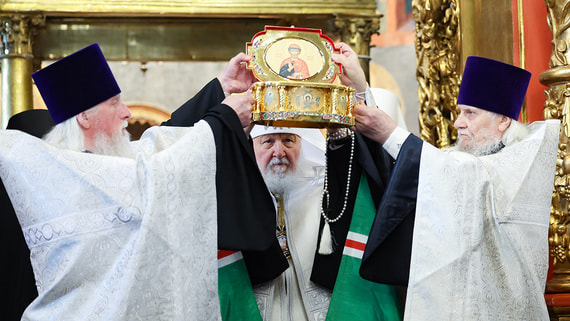
In a significant religious and historical development, fragments of the holy relics of Saint Prince Dmitry Donskoy, discovered in July during restoration work at the Archangel Cathedral of the Moscow Kremlin, will be placed in several reliquaries for veneration by Orthodox believers. The Russian Orthodox Church announced this decision on August 18, marking a momentous occasion for the faithful who revere the medieval warrior prince as one of Russia’s most important saints.
According to the Moscow Patriarchate’s official statement, the fragments were carefully selected from among those freely positioned within the sarcophagus. The decision to place them in special reliquaries was blessed by the head of the Russian Orthodox Church, Patriarch Kirill, who conducted a special divine service at the cathedral to mark the occasion. The careful handling of these sacred remains follows strict Orthodox protocols for the treatment of holy relics.
Patriarch Kirill’s Message to the Faithful
During the ceremony, Patriarch Kirill addressed the congregation with words emphasizing the spiritual significance of the discovery. “Let us pray to the holy blessed Prince Dimitry, that he may intercede before the Lord and ask our Savior for protection of our Fatherland, strength of spirit for our people, and most importantly, unity for all of us,” the Patriarch proclaimed to those gathered in the historic cathedral. His words reflected the traditional Orthodox belief in the intercessory power of saints and the particular importance of Dmitry Donskoy as a symbol of national unity and defense.
The Archangel Cathedral, where the relics were discovered, serves as the traditional burial place of Russian grand princes and tsars from the 14th through the 17th centuries. This magnificent structure, built between 1505 and 1508 by Italian architect Aloisio the New, houses the remains of numerous Russian rulers and has long been considered one of the most sacred sites in Russian Orthodoxy. The cathedral’s role as a royal necropolis makes it an invaluable repository of Russian religious and historical heritage.
The Legacy of Dmitry Donskoy
Dmitry Donskoy, who lived from 1350 to 1389, is celebrated as one of Russia’s greatest medieval rulers and military leaders. He earned his epithet “Donskoy” (“of the Don”) after his legendary victory at the Battle of Kulikovo in 1380, which took place near the Don River. This battle, though not the final blow against Mongol-Tatar domination, is considered a crucial turning point in Russian history, demonstrating that the Golden Horde could be defeated and inspiring future generations to continue the struggle for independence.
The prince was canonized by the Russian Orthodox Church in 1988, during the celebration of the millennium of the Christianization of Rus’. His canonization recognized not only his military achievements but also his piety and dedication to Orthodox Christian values. Throughout his reign, Dmitry worked closely with the Church, most notably with Saint Sergius of Radonezh, who blessed his campaign against the Mongols and whose spiritual guidance was considered instrumental in the Russian victory at Kulikovo.
Significance of the Discovery During Restoration
The discovery of Dmitry Donskoy’s relics came during ongoing restoration efforts at the Archangel Cathedral, which regularly undergoes maintenance and preservation work due to its immense historical and spiritual importance. Such discoveries during restoration projects are not uncommon in ancient Russian churches, where centuries of modifications and historical upheavals have sometimes obscured or displaced original burials and artifacts. The Kremlin’s museums and churches continue to yield historical treasures as modern conservation techniques allow for more thorough examination of these sacred spaces.
The decision to create three separate reliquaries for the relics will potentially allow for the veneration of Saint Dmitry Donskoy at multiple locations, extending the opportunity for pilgrimage and prayer to believers beyond Moscow. This practice of distributing fragments of saints’ relics has ancient precedent in Orthodox tradition, enabling the faithful across vast geographical distances to access these holy objects. For the Russian Orthodox Church and its millions of adherents, the availability of these newly discovered relics represents a profound spiritual gift and a tangible connection to one of Russia’s most revered historical and religious figures.
Expert Opinion: The timing and handling of this relic discovery reflects the Russian Orthodox Church’s continued emphasis on connecting contemporary Russian identity with medieval spiritual and military heritage. The distribution of relics across multiple reliquaries suggests an intention to maximize the pastoral impact of this discovery, potentially establishing new pilgrimage sites. This development will likely strengthen the Church’s role in promoting historical narratives that emphasize Russian unity and resilience in the face of external threats.